

Have you tried deep breathing for IBS?
I know what you're thinking, it sounds like one of those helpful things your doctor tells you to try, right after they say "It's only IBS"!
But hear me out...

Jump to:
The gut/brain connection
You see as much as we hate to hear, "It's all in your head." (Spoiler alert, it's not!) there is an undeniable connection between the gut and the brain.
These connections can be physical, such as signals transmitted through the nerves of the nervous system. They can also be chemical, such as through the release of mood-boosting serotonin from the brain or the gut.
Because this communication runs both ways what we think and how feel can affect our gut, and vice versa. How our gut feels can impact our mood and behaviour.
A big part of this physical connection is via the superhighway known as the vagus nerve, which sends signals in both directions.
The vagus nerve
The vagus nerve is the longest and most complex of the cranial nerves. It is responsible for controlling a number of essential involuntary functions such as;
- Heart rate.
- Blood pressure.
- Respiration, including the physical movement of the diaphragm and the speed and depth of the breath.
- Digestion, including saliva production and the motion and speed of how food moves through the stomach and intestines.
- Reflex actions such as fainting, swallowing, sneezing, coughing, vomiting and gag reflex.
The vagus nerve directly links the brain to the gut and is responsible for controlling our parasympathetic nervous system.
The parasympathetic nervous system
The parasympathetic nervous system controls our bodily functions when we are resting.
Activation of the parasympathetic nervous system is how we move from a heightened state of fight or flight into rest and digest mode.
In this state of relaxation our breathing and heart rate slows, blood pressure lowers and, most importantly for IBS sufferers, the digestive system is stimulated.
One of the simplest ways to activate our parasympathetic nervous system via the vagus nerve and start this chain reaction of relaxation and digestion is with deep belly breathing. There are many ways to get started but my personal favourite is box breathing.
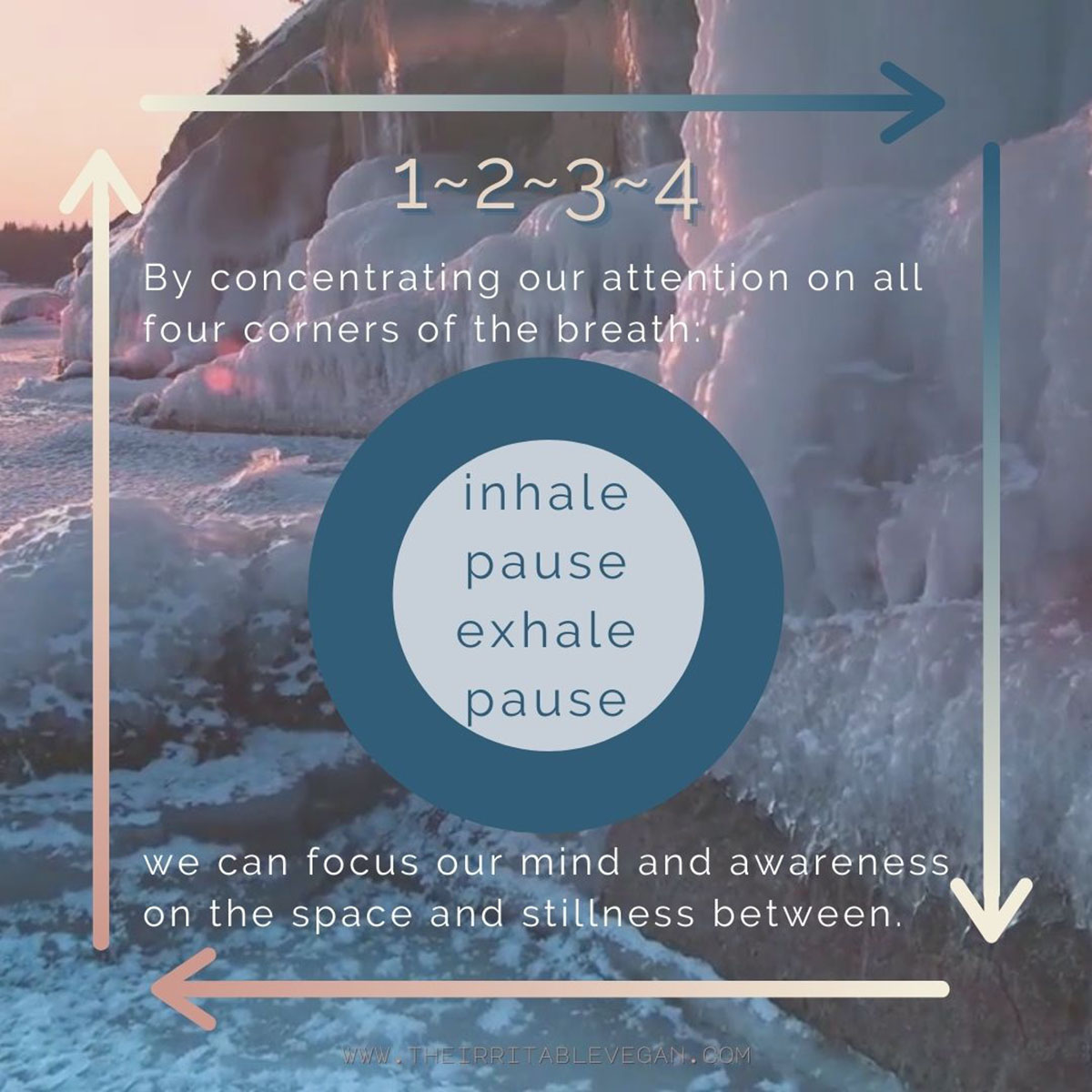
What is box breathing?
Box breathing, also known as;
- square breathing
- equal breath
- four-part breath
- tactical breathing
Is a technique used to quickly gain control of and slow the breath in order to subdue the fight or flight response.
Box breathing has long been used in martial arts, yoga and meditation as a way to connect body and mind. More recently it's been adopted by military personnel, law enforcement and emergency responders. The technique is used to quickly aid composure and recovery after a stress response and helps to mitigate the effects of adrenaline on the body.
Simple box breathing technique
- To begin, lie down or sit comfortably with your chest open, shoulders relaxed & your spine straight.
- Breathe in through the nose to a count of 4.
- Direct the breath deep into the belly rather than shallow breathing into the top of the lungs.
- After the inhale, pause for a count of 4 with your lungs full of air.
- Once you've paused for 4 seconds slowly exhale all the air for a count of 4.
- Pause again for a count of 4 before taking your next inhale. If you're new to deep breathing then this pause can be the hardest. You can reduce the pause to 2 seconds and work up from there if you prefer.
Imagine inflating the belly like a balloon with each inhale and deflating the belly fully with each exhale.
Repeat for 5 minutes or until you feel better.
Once you're comfortable with this sequence you can gradually extend the breath and pauses up to a maximum of 8 seconds.
A variation of this technique is to make the exhale longer than the inhale or pause. In this way, you would keep the count of 4 for everything except the exhale. Then extend each exhale up to a count of 6 or 8.
Box breathing tips
- Begin in a comfortable position that you can maintain for at least 5 minutes.
- Give equal time and focus to all four parts of the breath.
- Think of the time between breaths as a pause rather than a hold.
- Pause without clamping the mouth shut, constricting the throat, tensing the shoulders or clenching the jaw.
- Inhale without gulping, gasping or reaching for the breath.
- Exhale without wheezing, forcing or blowing.
- If your mind can't focus on anything except the next breath then reduce the timings until you feel more relaxed.
Contraindications to box breathing
Whilst deep breathing is almost always beneficial for us the pauses in box breathing may not suitable for everyone. Some people simply don't like them whilst others should actively not attempt them. If any of the following apply to you please speak to a health professional before you begin.
- Pregnancy: Pausing the breath is not advised during pregnancy. However, deepening and equalising the inhale and exhale can be performed without either of the pauses in between.
2. Anyone suffering from the following conditions:
- High blood pressure
- Heart conditions
- Lung or breathing conditions
- Eye conditions
- Ear conditions
Should practice without pausing after the in-breath. This is to avoid causing any strain, tension or a build-up of pressure as the air is held in the lungs.
3. Anyone suffering from:
- Low blood pressure
- Breathing conditions
- Dizziness
- Prone to fainting
Should practice without pausing after the out-breath. This is to avoid respiration and blood pressure from dropping too much as the air is depleted.
Equal breathing, where we deepen and lengthen the inhale and exhale, can be safely performed by everyone, without pauses in between.
Guided deep breathing meditation for IBS
Try box breathing the next time you feel stressed, experience stomach cramps or a flare-up. Let me know how it worked for you in the comments below.
If you liked this post then you'll love this one where I explain how I went 900 miles outside of my comfort zone whilst keeping my IBS in check!
Further Reading
VAN DER VEEK, P.P.J. et al. (2007), Clinical trial: short- and long-term benefit of relaxation training for irritable bowel syndrome. Alimentary Pharmacology & Therapeutics, 26: 943-952. https://doi.org/10.1111/j.1365-2036.2007.03437.x
Jurek, Mary Katherine. et al. (2020) "The Effects of Slow Deep Breathing on Measures of Microvascular and Autonomic Function in an Irritable Bowel Syndrome Population," International Journal of Exercise Science: Conference Proceedings: Vol. 2 : Iss. 12 , Article 83. https://digitalcommons.wku.edu/ijesab/vol2/iss12/83


Comments
No Comments